
Corporate Governance
Basic Approach to Corporate Governance
The corporate governance of the Company and the company group comprising its subsidiaries (hereinafter called the “Group”) is based on the development and operation of a system to ensure that actions are based on the company’s corporate philosophy and decisions are made in a transparent, fair, and efficient manner, and compliance with laws and regulations and appropriate supervision (monitoring) of corporate performance are carried out under the mission of "To inspire the world with entrepreneurship".

The Outline of Corporate Governance Structure
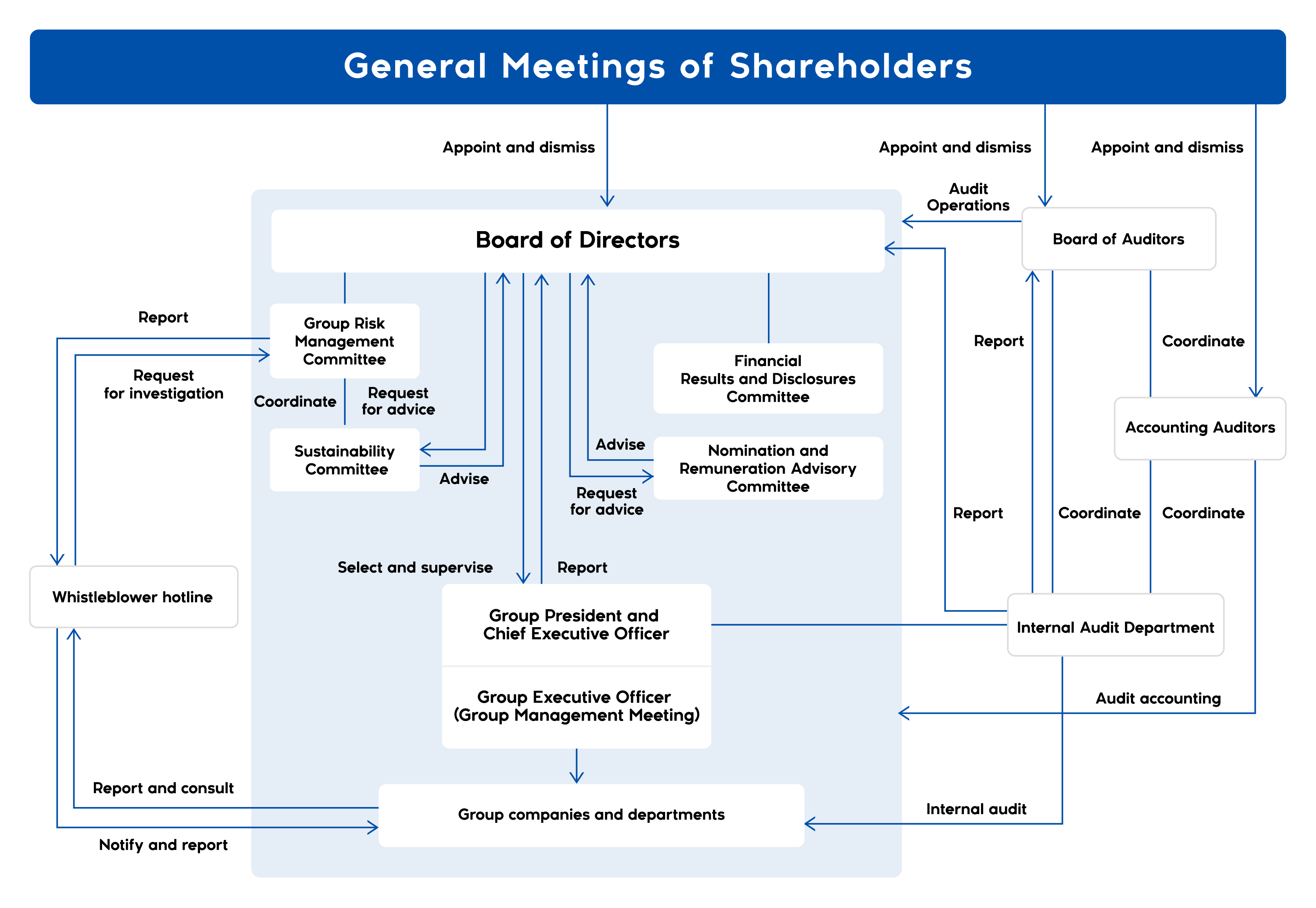
The Group is managed under a holding company structure in which the Company is a holding company and its group companies are operating companies. By separating the function of administering its overall business from executing its individual businesses, the Group has been working to facilitate the delegation of authority and strengthen the Company’s function of monitoring the Group’s businesses.
The Board of Directors
The board of directors shall consist of a majority, at the minimum, of highly independent outside directors. The board currently consists of seven directors, four of whom are outside directors. It determines matters prescribed by laws and regulations and the Articles of Incorporation and matters concerning the execution of important business and oversees the execution of business. Furthermore, as part of strengthening of its corporate governance system, the Company introduced an executive officer system in January 2017. Under this system, the authority for making decisions and executing business operation is delegated to executive officers (hereinafter, “group executive officers”) to the extent permitted by relevant laws and regulations, in order for the board of directors to mainly focus on the oversight (monitoring) of the group executive officers who are responsible for the execution of business (monitoring model-oriented).
The Group Executive Officers
The group executive officers are responsible for the execution of business of the Company, that of the business companies in its group or that across several business companies. The board of directors appoints group executive officers in charge of respective areas of business operation, and the group president and chief executive officer who concurrently serves as representative director oversees the execution of business operations by the group executive officers.
Moreover, matters to be resolved by meetings of the board of directors, those regarding which authority is to be delegated to the group executive officers and those to be reported by the group executive officers to the Company’s board of directors are clearly stipulated in the regulations of the board of directors.
In addition to the above, Group Management Meeting has been established, as a system regarding decision-making on the execution of business, with the functions of supporting decision-making by the group president and chief executive officer and of considering important managerial matters of the group. The Company has also established a Group Risk Management Committee that supervises risk management of the group, a Sustainability Committee that promotes sustainability activities to enhance the corporate value and a Financial Results and Disclosures Committee that reviews and evaluates financial results information, information for timely disclosure, among other things. In doing so, the Company has put in place a system that clarifies authority and responsibilities and enables prompt and appropriate decision-making.
Nomination and Remuneration Advisory Committee
The Nomination and Remuneration Advisory Committee, the majority of which consists of outside directors, has been established as an optional committee of the board of directors to handle personnel matters regarding the group’s management team (appointment, removal etc., of directors of the Company, group executive officers and others) and remuneration (individual remuneration, etc., for directors of the Company, group executive officers and others for the fiscal year) in order to ensure the independence, objectivity and accountability of the deliberation process.
<Activities in FY2025>
| Members | Number of committee members in attendance |
Attendance Rate |
|---|---|---|
| Yoshiki Ishikawa(Chairperson, Outside Director) | 7/7 | 100% |
| Makoto Shiono (Member/Vice chairperson, Outside Director) | 7/7 (o/w 6 times as vice chairperson) |
100% |
| Akie Iriyama (Outside Director) | 7/7 | 100% |
| Mio Takaoka (Outside Director) | 7/7 | 100% |
| Yuichi Kouno (Representative Director) | 7/7 | 100% |
| Etsuko Okajima(Vice chairperson, Outside Director) | 1/1 | 100%*1 |
<Activities in FY2025>
| Members | Number of committee members in attendance |
Attendance Rate |
|---|---|---|
| Yoshiki Ishikawa(Chairperson, Outside Director) | 7/7 | 100% |
| Makoto Shiono (Member/Vice chairperson, Outside Director) | 7/7 (o/w 6 times as chairperson) | 100% |
| Akie Iriyama (Outside Director) | 7/7 | 100% |
| Mio Takaoka (Outside Director) | 7/7 | 100% |
| Yuichi Kouno (Representative Director) | 7/7 | 100% |
| Etsuko Okajima(Vice chairperson, Outside Director) | 1/1 | 100%*1 |
*1 The attendance at the Nomination and Remuneration Advisory Committee meetings represents the attendance before their retiring from office on March 26, 2025.
Executive Session
Meetings attended only by the outside directors (Executive Session) are held once a month in principle, thereby securing a place for information exchange and shared awareness from objective standpoints. Outside corporate auditors, external accounting auditors and other independent outside persons may attend such meetings, thereby providing a place for promoting cooperation among independent outside persons.
Corporate Auditor System
The Company has adopted a corporate auditor system. Under the system, there are currently four corporate auditors including three highly independent outside corporate auditors. Each corporate auditor audits the execution of business by the directors, in accordance with the auditing policy, audit plans and so forth determined by the board of corporate auditors.
Corporate Governance System
Progress of Governance Reforms
- FY9/2015
-
- Systematization of governance for greater effectiveness
- Increased to two
(including a female director)
- FY9/2016
-
- Introduction of effectiveness evaluation to enhance the functioning of the board of directors
- Establishment of the Financial Results and Disclosures Committee and the CSR Committee
- Abolition of anti-takeover measures
- Establishment of the Group Risk Management Committee
- FY9/2017
-
- Introduction of a performance-linked share-based compensation plan for officers
- Seperation of execution and monitoring through the introduction of a delegated executive officer system
-
Outside directors become
the majority of
the board of directors
- FY2022
-
- Enhancement of sustainability initiatives through the establishment of the Sustainability Committee
- FY2023
-
- Establishment of the Nomination and Remuneration Advisory Committee
- FY2026
-
- Expansion of the performance-linked share-based compensation plan to include outside directors (fixed portion only)
Governance Highlights
(FY2025)
- Number of Directors
(Outside Directors Included in Total) - 7(4)
- Number of Board of Directors' Meeting Held
- 14
- Average Attendance Rates at Borad of Directors' Meetings
Directors - 99%
- Auditors
- 98%
- Number of Auditors
(Outside Auditors Included in Total) - 4(3)
- Number of Borad of Auditors' Meetings Held
- 14
- Average Auditor Attendance Rate at Board of Auditors' Meetings
- 98%
Evaluation of the Effectiveness of the Board of Directors
With the aim of enhancing the function of the board of directors, the Company conducts analysis, evaluation and follow-up examinations of issues on the effectiveness of the board of directors once a year in principle. The Company also conducts large-scale and detailed surveys by external third-party institutions once every three years.
In FY2025, the Company conducted a questionnaire for all directors and corporate auditors, supplemented by interviews with directors, based on advice from an external third-party organization.
As a result, the board of directors confirmed that it maintains a high level of effectiveness, characterized by the following strengths:
- Engaging in merit-based discussions in a flat, interactive and positive atmosphere while maintaining a balance of mutual trust and constructive tension.
- Operating the board effectively through sufficient communication and proactive improvements.
- Sharing a common understanding of the board of directors' mission.
- Maintaining high standards of professionalism expected of all directors.
Going forward, the Company will maintain the identified strengths as both the culture and the foundation that support board effectiveness. Simultaneously, by addressing the identified challenges—specifically "realizing planned and strategic board succession over a long-term horizon"—the Company will continue to further enhance the effectiveness of the board of directors.
Officer Remuneration Plan
In FY9/2017, the Group introduced a new performance-linked share-based remuneration plan (the "Plan") to clarify the link between remuneration for directors (excluding outside directors and non-residents of Japan) and executive officers (excluding non-residents of Japan) and the Group's medium- to long-term performance and shareholder value. The goal is for remuneration to serve as a healthy incentive for improving medium- to long-term performance and increasing corporate value.
A proposal to partially amend the Plan, including adding outside directors as eligible participants, was submitted to and approved at the 35th Ordinary General Meeting of Shareholders held on March 25, 2026.
Accordingly, remuneration for the Company’s directors (excluding outside directors) is composed of monthly remuneration and share-based remuneration (Fixed Portion and Performance-linked Portion).
Determined by grade according to the scope and weight of each individual’s responsibilities. The total monthly cash remuneration must remain within the limit approved by the General Meeting of Shareholders.
Share-based remuneration (Long-term Incentive):
Fixed Portion: Consists of Base Points granted annually according to the individual's position.
Performance-linked Portion: Consists of Performance-linked Points granted at the end of the covered period based on the individual's position, and the degree of achievement of performance targets during said period, with such targets established under the medium- to long-term business plan, including consolidated Non-GAAP operating profit, profit attributable to owners of parent, and consolidated ROE.
Remuneration for outside directors is composed of monthly remuneration and share-based remuneration (Fixed Portion).
Remuneration for corporate auditors is composed of only monthly basic remuneration (fixed with no changes based on performance).
Following the above policy, monthly remuneration for directors (excluding outside directors) will be within the total limit of director remuneration set by a resolution of the general meeting of shareholders, and individual and specific allocations will be decided by the group president and chief executive officer referencing the proposed recommendations of the Nomination and Remuneration Advisory Committee. Regarding share-based remuneration (Fixed Portion and Performance-linked Portion), the “share delivery rules” will be concluded with the trustee of the trust based on the share-based remuneration system using the directors’ remuneration BIP trust resolved by the general meeting of shareholders, and according to these rules, the trustee will deliver shares.
Following the above policy, remuneration for outside directors will be within the total limit of director remuneration set by a resolution of the general meeting of shareholders, and individual and specific allocations will be decided by the group president and chief executive officer referencing the proposed recommendations of the Nomination and Remuneration Advisory Committee. Regarding share-based remuneration (Fixed Portion), the “share delivery rules” will be concluded with the trustee of the trust based on the share-based remuneration system using the directors’ remuneration BIP trust resolved by the general meeting of shareholders, and according to these rules, the trustee will deliver shares.
Following the above policy, remuneration for corporate auditors will be within the total limit of corporate auditor remuneration set by a resolution of the general meeting of shareholders, and individual and specific allocations will be decided through discussions with the corporate auditors.
BIP Trust
The Plan is designed to further clarify the link between the Group’s share value and remuneration for the Company’s directors and executive officers (excluding non-residents of Japan). Under the Plan, the Company’s shares are purchased from the market as officer remuneration, held in a trust account, and granted to eligible individuals based on their position and the degree of achievement of performance targets.
*1 Share-based remuneration for outside directors is limited to the Fixed Portion only.
*2 For further details, please refer to the disclosure documents below.
- 2016.11.22 Notice Regarding Adoption of Performance-Based Stock Compensation Plan for OfficersPDF638KB
- 2019.11.26 Notice Regarding Continuation of Performance-Linked Stock Compensation Plan for OfficersPDF638KB
- 2022.11.26 Notice on the Continuation and Partial Revision of the Performance-Linked Stock Compensation Plan for Directors and OfficersPDF638KB
- 2023.4.25 Notice of Change in Share Acquisition Period under Performance-Linked Stock Compensation Plan for Directors and OfficersPDF125KB
- 2026.2.24 Notice on the Continuation and Partial Revision of the Performance-Linked Share-Based Compensation Plan for Directors and OfficersPDF218KB
Director and Auditor Remuneration
FY2025 (units:thousand yen)| Category | Number of payees | Total amount of officers’ remunerations, etc. | Total amount of remunerations, etc. by type | |
|---|---|---|---|---|
| Basic remuneration | Performance-linked remuneration, etc. | |||
| Non-monetary remuneration, etc. | ||||
| Director (of which Outside Director) |
7 (5) |
78,000 (¥63,000) |
78,000 (¥63,000) |
- (¥–) |
| Company Auditor (of which Outside Company Auditor) |
3 (3) |
24,000 (¥24,000) |
24,000 (¥24,000) |
- (¥–) |
| Category | Number of payees | Total amount of officers’ remunerations, etc. | Total amount of remunerations, etc. by type | |
|---|---|---|---|---|
| Basic remuneration | Performance-linked remuneration, etc. | |||
| Non-monetary remuneration, etc. | ||||
| Director (of which Outside Director) |
7 (5) |
78,000 (¥63,000) |
78,000 (¥63,000) |
- (¥–) |
| Company Auditor (of which Outside Company Auditor) |
3 (3) |
24,000 (¥24,000) |
24,000 (¥24,000) |
- (¥–) |
Notes:
- The amounts of directors’ compensation do not include compensation as Group Executive Officers. The total amount of directors’ remuneration, including remuneration as Group Executive Officers, is ¥173,526 thousand, consisting of basic compensation of ¥150,012 thousand and performance-linked compensation (cash) of ¥23,514 thousand.
- The number of payees and the amount of remunerations include one director and the amount of renumeration during their service, who retired from office at the conclusion of the 34th Ordinary General Meeting of Shareholders held on March 26, 2025.
- The total amount of officer’s remunerations etc., total amount of remunerations, etc. by type., and the number of eligible officers do not include one director and one company auditor all of whom serve without remuneration.
- The Company is introducing a performance-linked share-based remuneration system using the directors’ remuneration BIP (Board Incentive Plan) trust scheme for directors of the Company (excluding outside directors and those who are nonresidents of Japan). Covenants, etc. at the time of allotments are provided in “(a) Policy for determining details of remunerations, etc. for officers,” and the delivery status in the business year under review is provided in “2. (1) 5) Status of shares delivered to the Company’s officers as remuneration for the execution of duties during the business year under review.”
- The performance indicator associated with performance-linked remuneration, etc. is consolidated Non-GAAP operating profit, and those results are provided in “1. (1) Business progress and results,” and “1. (2) Trends in financial position and profit and loss.” As the reason for selecting this indicator, the Company has deemed that this is an appropriate indicator for evaluating the achievement of improvements to the medium- to long-term corporate value. In calculating performance-linked remuneration, basic points are allotted in a set period during each business year according to the role of each director and the level of achievement, etc. of performance targets during the covered trust period of the directors’ remuneration BIP trust. After the conclusion of the covered period, additional points allotted to persons covered by the system on the last day of the final business year of the covered period are cumulatively added to the cumulative value of basic points (“Cumulative Points”). A number of the Company’s shares equal to the number of Cumulative Points is delivered or paid to persons covered by the system as share-based remuneration. Furthermore, 50% of the shares corresponding to the points in question (share of less than one unit rounded down) will be delivered as shares, and from the standpoint of securing funds to pay taxes, the remainder will be converted into cash, and cash corresponding to the amount converted to cash will be paid.
- At the 23rd Ordinary General Meeting of Shareholders held on December 20, 2013, the amount of cash remuneration for directors was set at up to ¥600 million annually (not including the portion of employee salaries paid to directors concurrently serving as employees). The number of directors as of the conclusion of this ordinary general meeting of shareholders is eight. Furthermore, in a separate framework from cash remuneration, at the 26th Ordinary General Meeting of Shareholders held on December 20, 2016, the amount of trust funds provided to the trust as funds for the acquisition of the Company’ shares associated with the points allotted to directors (excluding outside directors and non-residents of Japan) as performance-linked share-based payments (directors’ remuneration BIP trust) was set at a maximum of ¥700 million, and the total points at a maximum of 2,800,000 points (corresponding to 2,800,000 shares) for three business years. The number of directors as of the conclusion of this ordinary general meeting of shareholders (excluding outside directors and nonresidents of Japan) is six. At the 32nd Ordinary General Meeting of Shareholders held on December 21, 2022, resolutions were passed to extend the trust period until May 31, 2026, and in conjunction with the change in the Company’s fiscal year-end, to continue with the plan under a new version in which some details were revised. The number of directors as of the conclusion of this ordinary general meeting of shareholders (excluding outside directors and non-residents of Japan) is two.
- The amount of cash remuneration for company auditors was set at a maximum of ¥50 million annually at the 9th Ordinary General Meeting of Shareholders held on December 14, 1999. The number of company auditors as of the conclusion of this ordinary general meeting of shareholders is one.
- The board of directors has delegated the decisions on the amounts of individual director remuneration to Yuichi Kouno, the Representative Director, Group President and Chief Executive Officer. The reason for the delegation is that the board of directors deemed that the Representative Director, Group President and Chief Executive Officer is best suited to conduct evaluations of the division for which each director is responsible while considering the Company’s overall performance, etc. The decisions on the delegated matters are made while referencing the proposed recommendations of the Nomination and Remuneration Advisory Committee to confirm the validity of remuneration levels.
Skills Matrix of Directors and Corporate Auditors
The Company has identified the skills required for the board of directors and board of corporate auditors as follows, and aims to strengthen the oversight function of management by ensuring that both boards collectively possess the necessary skills.
| Corporate Management |
Integrated Marketing |
Human Capital / Talent Development |
Financial Accounting / Finance |
Corporate Governance |
Sustainability | |
|---|---|---|---|---|---|---|
| Directors | ||||||
| Yuichi Kouno | ○ | ○ | ○ | ○ | ○ | |
| Yusuke Shimizu | ○ | ○ | ○ | |||
| Yoshiki Ishikawa | ○ | ○ | ○ | |||
| Akie Iriyama | ○ | ○ | ○ | |||
| Mio Takaoka | ○ | ○ | ○ | |||
| Makoto Shiono | ○ | ○ | ○ | |||
| Mitsuyuki Nakamura | ○ | ○ | ○ | |||
| Corporate Auditors | ||||||
| Tadahiro Mouri | ○ | ○ | ○ | |||
| Mamoru Furushima | ○ | ○ | ○ | |||
| Takeshi Okuyama | ○ | ○ | ○ | |||
| Hideo Hatano | ○ | ○ | ○ | |||
*Indicates skills and experience particularly expected from each individual.
| Skill item | Definition | Reason for selection |
|---|---|---|
| Corporate Management |
Expertise in discussing and evaluating growth strategies, including key themes such as generative AI, as well as business portfolio management, with the aim of sustainably enhancing Group corporate value. | Accurately evaluating the validity of the Group’s growth strategy and overseeing business portfolio management are required to achieve medium- to long-term corporate value enhancement. |
| Integrated Marketing |
Expertise in overseeing business strategies that support client challenges by integrating online and offline channels with digital methods as the starting point, including the use of data and AI and the promotion of digital transformation (DX). | As client challenges become more advanced and complex, an appropriate understanding of integrated marketing beyond the digital domain, along with evaluation and oversight of its execution, is required. |
| Human Capital / Talent Development |
Expertise in fostering entrepreneurship and organizational development toward the mission of “To inspire the world with entrepreneurship.” | Maximizing human capital, which is the source of the Company’s value creation, and overseeing organizational strategies that contribute to achieving the mission are required. |
| Financial Accounting / Finance |
Specialized expertise in understanding financial statements based on International Financial Reporting Standards (IFRS), and in formulating, evaluating, and executing capital policies, including shareholder returns, growth investments, and M&A, that balance high growth and high returns. | A deep understanding of IFRS-based financial conditions and the expertise to judge, evaluate, and execute the optimal balance of shareholder returns, growth investments, and M&A as capital policy are necessary to achieve both high growth and high returns. |
| Corporate Governance |
Expertise in strengthening the board of directors’ oversight of business execution, with due consideration given to legal compliance, compliance frameworks, and the protection of minority shareholders. | In particular, as a listed company with a parent company, building and overseeing a highly robust governance framework that gives due consideration to the protection of minority shareholders are required. |
| Sustainability | Expertise in overseeing responses to material issues and the practice of social responsibility that contributes to enhancing corporate value. | Addressing material issues and practicing social responsibility are essential to medium- to long-term corporate value enhancement. |
Reasons for Appointment of Directors
The reasons are described on the Our Executives page.